Tape Echo 2
Three-Head Tape Delay with Spring Reverb
Available Now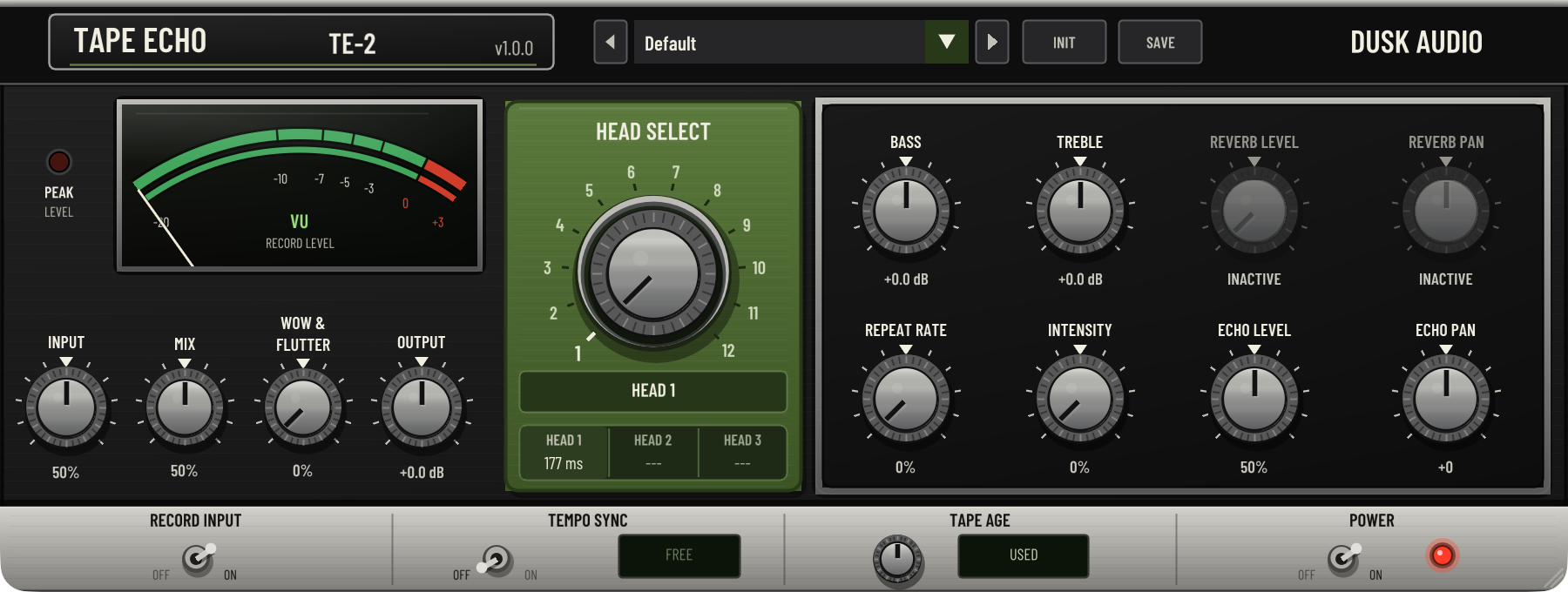
Tape Echo 2 is a three-head tape delay and spring reverb, modeled from the record head to the output amplifier. Completely free.
Overview
A tape echo is a loop of tape running past one record head and three playback heads. Where the heads sit determines the rhythm, how fast the motor turns determines the tempo, and how much signal you feed back onto the tape determines whether you get one repeat, a rhythmic cascade, or a howling runaway.
Tape Echo 2 models that machine rather than approximating it with a delay line. The three heads share a single motor, so moving the Repeat Rate moves all three together and the tape glides into its new speed the way a real transport does. Age the tape and the wow, flutter, hiss, and level wobble all worsen together. Push the regeneration and the loop saturates, compresses, and eventually self-oscillates.
Echo Modes
Twelve modes select which heads are active and whether the spring tank is in the path:
| Mode | Path |
|---|---|
| 1 | Head 1 |
| 2 | Head 2 |
| 3 | Head 3 |
| 4 | Heads 2 + 3 |
| 5 | Head 1 + Reverb |
| 6 | Head 2 + Reverb |
| 7 | Head 3 + Reverb |
| 8 | Heads 1 + 2 + Reverb |
| 9 | Heads 2 + 3 + Reverb |
| 10 | Heads 1 + 3 + Reverb |
| 11 | Heads 1 + 2 + 3 + Reverb |
| 12 | Reverb Only |
The Transport
One motor drives all three heads. Head 1 spans roughly 70 to 178 ms; heads 2 and 3 sit at fixed mechanical ratios beyond it, reaching about 490 ms at the slow end of the motor range.
Because the heads are mechanically linked, selecting a multi-head mode gives you a rhythm rather than a single echo, and changing the Repeat Rate transposes that whole rhythm at once. The motor has inertia, so a tempo change glides instead of jumping.
Tempo Sync
Eleven note detents derive the motor speed from the host tempo. The rhythmic value belongs to the leading active head, so the same detent reads differently in a Head 1 mode than in a Head 3 mode.
A real tape echo can only run its motor so slowly. Tempo Sync respects that: a note longer than the transport can carry is held at the motor’s maximum rather than transposed down, which is what the hardware does. Longer divisions therefore converge on the same timing at a given tempo, and slow tempos reach the limit sooner. Reach for a shorter division or a multi-head mode when you want the repeat to track the bar at low tempos.
Tape Age
Three cartridge conditions rather than a continuous wear knob:
| Condition | Character |
|---|---|
| New | Tightest timing, lowest noise, cleanest repeats |
| Used | Audible flutter, a little hiss, gentle level wobble |
| Old | Heavy scrape flutter, pronounced hiss, unstable level |
Age drives all of the transport’s imperfections together: wow, scrape flutter, tape hiss, and slow playback-level wobble each worsen on their own curve, the way a worn cartridge actually degrades.
Spring Reverb
The spring tank uses three unequal springs, spread widely enough that their transit times span about 5.6 ms. Each pair beats at the difference of its round-trip rate, and that beating is the tank’s movement: there is no LFO anywhere in it. Spacing the springs far apart gives fewer, faster beats that read as texture rather than the slow warble you get from bunching them together. Two short allpass diffusers then fill the gaps between the three arrivals, so the tail is dense instead of a set of spikes.
The send is linear across the full drive range, which means the spring keeps its character whether you feed it gently or hit it hard.
The Record Input switch mutes the feed to the tape while leaving the spring live, so you can hold a spring wash while the echoes decay away underneath it.
Regeneration and Self-Oscillation
Intensity controls how much of the playback signal is written back to the tape. Low settings give a single soft repeat. Mid settings build a decaying cascade. Past unity the loop stops decaying and starts growing.
Runaway is modeled through the tape rather than bolted on: the loop saturates the tape flux, the record chain compresses, and the oscillation settles into a howl rather than clipping into digital noise.
Factory Presets
Thirteen presets covering the machine’s range:
Starting Point
- Default
Short and Rhythmic
- Slapback Vocal, Rockabilly Guitar, Classic Tape Echo
Dub and Multi-Head
- Dub Throw, Synced 1/8 Dub, Multi-Head Bounce, Orbital Echo
Ambient
- Full Wash, Ambient Trails
Character
- Worn Tape, Runaway Drone, Spring Only
Metering
The VU meter reads the record path, after the input amplifier and immediately before the tape. It shows what is actually being written, including the regenerated signal, so you can see the loop building before you hear it run away. The peak lamp is referenced to digital full scale and lights just below clipping.
Technical Specifications
DSP Details
- Record chain: oversampled preamp with latency-compensated halfband filtering
- Heads: three fixed mechanical ratios from one motor position, Hermite-interpolated
- Modulation: wow, sinusoidal flutter, and band-limited scrape flutter, all age-coupled
- Spring tank: three unequal springs with allpass dispersion and modeled pickup taps
- Metering: record-path VU with analog ballistics plus a peak lamp
Parameter Ranges
- Repeat Rate: full motor range, about 70 to 178 ms at Head 1
- Intensity: 0 to 100%, self-oscillating at the top of the range
- Echo and Reverb Volume: independent, each with its own pan
- Bass and Treble: tone controls on the echo return
- Output Volume: -20 dB to +20 dB
- Mix: dry only at 0%, both paths at unity at 50%, fully wet at 100%
Installation
Linux
VST3: ~/.vst3/tape_echo.vst3
CLAP: ~/.clap/tape_echo.clap
LV2:  ~/.lv2/tape_echo.lv2
macOS
AU:   ~/Library/Audio/Plug-Ins/Components/tape_echo.component
VST3: ~/Library/Audio/Plug-Ins/VST3/tape_echo.vst3
CLAP: ~/Library/Audio/Plug-Ins/CLAP/tape_echo.clap
LV2:  ~/Library/Audio/Plug-Ins/LV2/tape_echo.lv2
Windows
VST3: C:\Program Files\Common Files\VST3\tape_echo.vst3
CLAP: C:\Program Files\Common Files\CLAP\tape_echo.clap
Open Source
Tape Echo 2 is open source under GPL-3.0-or-later. View the source, report issues, or contribute on GitHub.
Disclaimer: This is an independent emulation inspired by classic tape echo hardware. This project is not affiliated with or endorsed by any hardware manufacturer.
Features
- 12 echo modes covering every head and reverb combination
- Three playback heads at fixed mechanical ratios, driven by one motor
- Spring reverb tank with three unequal springs and a dispersive tail
- Tape saturation with a modeled record and playback chain
- Tape Age in three cartridge conditions: New, Used, Old
- Wow and flutter that worsen with tape age, as on the hardware
- Automatic splice dropout as the tape join circulates past the heads
- Regeneration that runs from a single repeat into self-oscillation
- Tempo sync across eleven note detents, held to the motor range as on the hardware
- Record-path VU meter with peak lamp
- Dry/wet mix plus independent echo and spring panning
- Record-input switch that mutes the tape feed while the spring stays live
- 13 factory presets
- Resizable interface
- Full automation support
Changelog
v1.0.7 2026-09-06
- Framework update (DAF 22b82824, pugl d46e7871): the first click on an unfocused editor registers on macOS, macOS resize sizing fix, drawing state set up on the expose path, AU buffer handling fix, Wayland backend updated
v1.0.6 2026-08-29
- Fixed knob dragging stopping when the plugin window loses keyboard focus mid-drag
- Editor resizes are now negotiated correctly with CLAP hosts that keep the window on a fixed aspect ratio
v1.0.5 2026-08-28
- Fixed VST3 meter output parameters being reported to the host as parameter edits, which churned the undo history in hosts such as Bitwig until Undo and Redo were no longer offered, and marked the project modified on every save (#233)
- Added VST3 and CLAP regression harnesses, plus an editor drag test, that fail the build if output parameters reach the host or if a knob stops responding to the mouse
v1.0.3 2026-08-26
- Fixed CLAP record VU and peak meters being reported to the host as parameter changes, which made hosts such as Bitwig mark the project modified and constantly override the last-touched parameter
- User presets: storage deduplicated in the shared framework layer
v1.0.2 2026-08-15
- Crash logs are now captured; the supporters overlay has an "Open crash log folder" link
- Linux downloads: one archive per architecture (x64, arm64), no more duplicate archive pairs
v1.0.1 2026-08-13
- Fixed the editor rendering as a mostly black window in hosts that never resize the plugin view, such as MuLab 9
- Fixed every label rendering as a solid block on software OpenGL, as found in virtual machines and Remote Desktop sessions
- Fixed the power switch failing to turn the effect back on in CLAP hosts that stop processing a bypassed plugin, such as Reaper
- Mono instances now follow the channel count the host negotiates
- Filter design frequencies are clamped below Nyquist at unusually low sample rates
v1.0.0 2026-08-04
- Ground-up rebuild of Tape Echo on DAF (Dusk Audio Framework), our own framework derived from DPF, with AU, VST3, CLAP, and LV2 support
- Three-head transport with mechanical head ratios across the full motor range
- Spring reverb tank rebuilt with a linear send and recalibrated recurrence
- Tape age drives wow, flutter, hiss, and level wobble together
- Self-oscillation reworked so runaway builds from the tape flux, not loop gain alone
- Tempo sync across eleven note detents, held to the transport's physical range
- Record-path VU and peak metering
- 13 factory presets