1 / 2
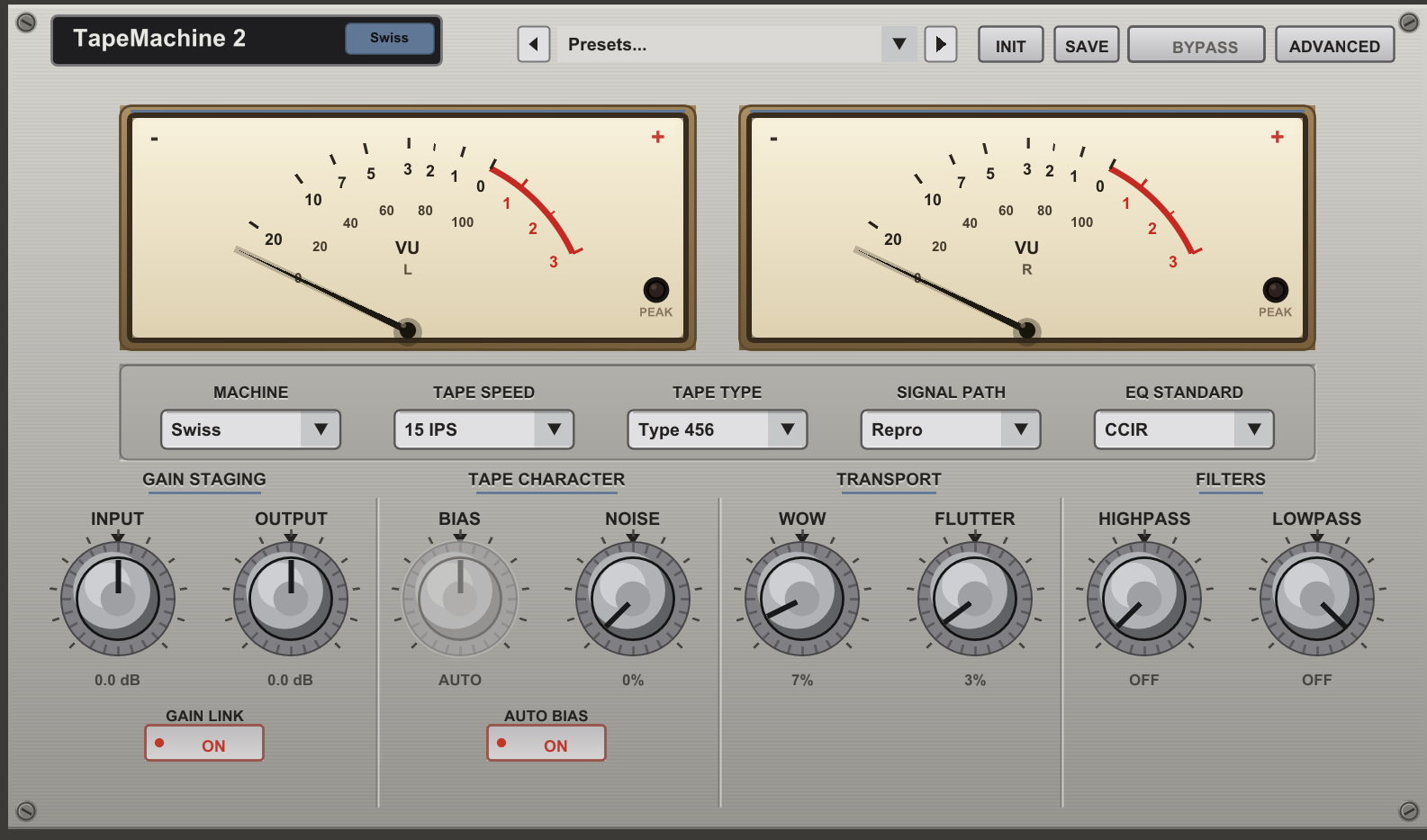
TapeMachine 2 is the next-generation Dusk Audio tape engine with two faithfully modeled reel-to-reel machines, each bringing authentic saturation, head response, and machine character. Completely free.
Overview
Analog tape has shaped the sound of recorded music for decades. TapeMachine 2 captures the magic of two legendary studio machines with anti-aliased waveshaping saturation and per-speed head-response modeling, tuned against reference hardware behavior.
Whether you want subtle glue on your mix bus, punchy tracking color, or heavy lo-fi character, TapeMachine 2 delivers authentic tape sound across two distinct machines.
Tape Machine Models
TapeMachine 2 recreates two iconic decks, each with its own saturation character and head response:
Swiss (A800-style)
- Clean, punchy, and precise
- Transformerless signal path
- Tight low end with extended highs
- The modern studio workhorse
American (ATR-102-style)
- Warm, rich, and musical
- Transformer coloration with adjustable head width
- Pronounced head bump and smooth top end
- ATR-style front-panel toggles: Crosstalk, Wow & Flutter, and Transformer
- The mastering room classic
Tape Formulations
Choose from four tape types, each with distinct sonic characteristics:
| Type | Character | Best For |
|---|---|---|
| 456 | Warm, punchy saturation | Rock, pop, mix bus |
| GP9 | Clean, extended headroom | Mastering, classical |
| 900 | European precision | Warmth, character |
| 250 | Vintage, early saturation | Lo-fi, creative effects |
Tape Speeds
Four selectable speeds, each with its own head bump and high-frequency response:
| Speed | Character |
|---|---|
| 30 IPS | Tightest low end, most extended highs |
| 15 IPS | The studio standard, balanced head bump |
| 7.5 IPS | Warmer, more pronounced low-frequency bump |
| 3.75 IPS | Lo-fi character (American) |
Signal Path Modes
Like a real tape machine, TapeMachine 2 offers multiple signal paths:
| Mode | Description |
|---|---|
| Repro | Full tape processing, the classic sound |
| Sync | Record-head playback with extra HF rolloff (for overdub workflows) |
| Input | Electronics only, hear just transformers and EQ coloration |
| Thru | Clean bypass for A/B comparison |
EQ Standards
Two professional equalization standards on both machines:
| Standard | Character |
|---|---|
| NAB | American: more HF pre-emphasis, warmer saturation |
| CCIR | European: balanced, precise response |
Head Width & Bias
- Head width (American machine only): 1/4”, 1/2”, or 1” head stack for different weight and low-end behavior.
- Bias & Auto Bias: dial in bias manually, or let Auto Bias find the optimal operating point.
- Auto Compensation: holds unity output while driving the tape for color, so louder saturation never means a louder mix.
Repro EQ
A four-band advanced Repro EQ models the hardware repro-head path:
- LF shelf: low-frequency weight and body
- LMF peak: low-mid warmth and fullness
- HMF peak: presence and high-mid detail
- HF shelf: air and top-end sheen
Wow & Flutter
TapeMachine 2 features separate controls for wow and flutter:
Wow: slow pitch drift
- Creates subtle vinyl-like wobble
- Adds organic movement to sustained notes
- Perfect for lo-fi and vintage vibes
Flutter: faster modulation
- Adds tape machine character
- Creates subtle chorus-like effects
Both effects share coherent stereo processing for a natural, phase-aligned sound, and can be disabled together from the American front panel.
Factory Presets
TapeMachine 2 ships with 20 factory presets, each modeled on the hardware units’ classic settings, across five categories:
American: Master
- Big 456 Master, Nice 456 Master, Jazz Vision Master, Clean 900 Master
American: Color
- Fat 456 Master, GP9 Drum Bus, Bass Bump, Bright & Sizzly
Swiss: Mix
- Classic Rock Crisp, Modern Rock, Drum Bus, Hi-Fi Shine, Lush Film, Jazz Warmth
Swiss: Color
- Thick Saturation, Hip-Hop Punch, Vocal Presence
Lo-Fi
- Sunbaked Cassette, Analog Warmth, Old Tape
Technical Specifications
DSP Details
- Saturation: anti-aliased waveshaping with per-speed head-bump and HF response modeling
- Oversampling: fixed 2x core with deep local anti-aliasing (ADAA) on the nonlinearities for alias-free saturation with no user tuning needed
- Repro path: four-band advanced Repro EQ modeled on the hardware repro head
- Metering: dual stereo VU meters with vintage analog ballistics
Parameter Ranges
- Input Gain (drive): ±12dB
- Output Gain: ±12dB
- Bias: 0 to 100%
- Wow: 0 to 100%
- Flutter: 0 to 100%
- Highpass Filter: 20 to 500 Hz
- Lowpass Filter: 3 kHz to 20 kHz
- Repro EQ (per band): ±12dB
Installation
Linux
VST3: ~/.vst3/TapeMachine2.vst3
CLAP: ~/.clap/TapeMachine2.clap
LV2:  ~/.lv2/TapeMachine2.lv2
macOS
AU:   ~/Library/Audio/Plug-Ins/Components/TapeMachine2.component
VST3: ~/Library/Audio/Plug-Ins/VST3/TapeMachine2.vst3
CLAP: ~/Library/Audio/Plug-Ins/CLAP/TapeMachine2.clap
LV2:  ~/Library/Audio/Plug-Ins/LV2/TapeMachine2.lv2
Windows
VST3: C:\Program Files\Common Files\VST3\TapeMachine2.vst3
CLAP: C:\Program Files\Common Files\CLAP\TapeMachine2.clap
Open Source
TapeMachine 2 is open source under GPL-3.0. View the source, report issues, or contribute on GitHub.
Disclaimer: This is an independent emulation inspired by classic tape machines. This project is not affiliated with or endorsed by any hardware manufacturer.
Features
- Two modeled machines: Swiss (A800-style) and American (ATR-102-style)
- Anti-aliased waveshaping saturation (ADAA with internal oversampling)
- Per-speed head bump and high-frequency response modeling
- Four tape speeds: 3.75, 7.5, 15, and 30 IPS
- Four tape formulations: 456, GP9, 900, 250
- Adjustable head width (American machine): 1/4", 1/2", 1"
- Machine-authentic front-panel toggles: Crosstalk, Wow & Flutter, Transformer
- Four signal path modes: Repro, Sync, Input, Thru
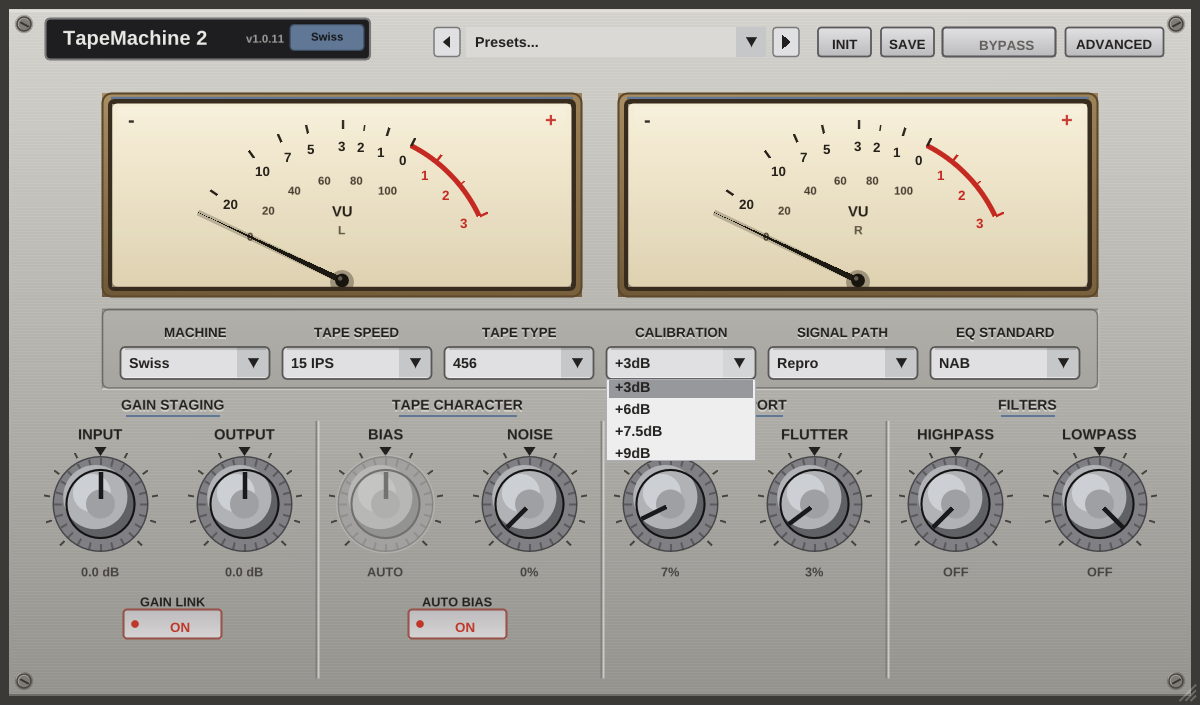
- Faceplate calibration: +3, +6, +7.5, and +9 dB operating levels
- NAB and CCIR EQ standards
- Separate Wow & Flutter controls with coherent stereo processing
- Four-band advanced Repro EQ (LF / LMF / HMF / HF)
- Bias and Auto Bias controls for fine-tuning tape response
- Auto Compensation mode for unity gain across drive levels
- Dual stereo VU meters with vintage analog styling
- 20 factory presets modeled on the hardware units' classic settings
- Resizable interface
- Full automation support
Changelog
v1.0.11 2026-09-06
- Calibration control on the faceplate (#144)
- VU meter drawn with the shared needle meter
- Framework update (DAF 22b82824, pugl d46e7871): the first click on an unfocused editor registers on macOS, macOS resize sizing fix, drawing state set up on the expose path, AU buffer handling fix, Wayland backend updated
v1.0.10 2026-08-29
- Fixed the window aspect the plugin reports to the host: it advertised 400x260 against an 800x470 design, so hosts that keep a plugin window on a fixed aspect sized the editor off its design
- Fixed knob dragging stopping when the plugin window loses keyboard focus mid-drag
v1.0.9 2026-08-28
- Fixed VST3 meter output parameters being reported to the host as parameter edits, which churned the undo history in hosts such as Bitwig until Undo and Redo were no longer offered, and marked the project modified on every save (#233)
- Added VST3 and CLAP regression harnesses, plus an editor drag test, that fail the build if output parameters reach the host or if a knob stops responding to the mouse
v1.0.7 2026-08-26
- Fixed CLAP VU meter output parameters being reported to the host as parameter changes, which made hosts such as Bitwig mark the project modified and constantly override the last-touched parameter (#231)
- User presets: storage deduplicated in the shared framework layer
v1.0.6 2026-08-15
- Crash logs are now captured; the supporters overlay has an "Open crash log folder" link
- Linux downloads: one archive per architecture (x64, arm64), no more duplicate archive pairs
v1.0.5 2026-08-13
- Fixed non-finite output at unusually low sample rates: every filter design frequency is now clamped below Nyquist
- Fixed a volume spike when changing presets
- Fixed the tape speed dropdown showing a question mark instead of the inch mark
- Gain Link holds levels more consistently across bypass, preset and processing changes
- EQ stages at 0 dB are now bypassed exactly, removing a low-frequency numerical residue at high sample rates
- Mono instances follow the channel count the host negotiates
- Removed the redundant peak light and refined the knob readouts
- The UI now shows the plugin version
v1.0.4 2026-07-24
- Fixed the LV2 version failing to load in strict hosts (Ardour reported no ports; Reaper reported a TTL parse error). The Head Width labels now use a proper inch mark that keeps the plugin metadata valid.
v1.0.3 2026-07-23
- User Manual PDF is now bundled inside every download archive, alongside the plugin folders, instead of only as a separate download
v1.0.2 2026-07-23
- Gain-link smoothing keeps output volume parity through preset switches, fixing a transient level jump on large preset changes
v1.0.1 2026-07-19
- Program-band tone matching: new correction bands keyed to a 500 Hz program envelope, neutral at the calibration anchor
- Deep-sub program bloom restores the reference decks' low-end thickening on hot material
- Per-preset repro sub-bell and lowpass resonance for closer factory-preset matching
- Crosstalk retuned to the reference; presets now honor their own Crosstalk switch
- Preset "Massive Bass" renamed "Bass Bump"
- Click the title nameplate to view Patreon supporters
- Fixed presets resetting when closing the DAW, and a gain-linking issue
v1.0.0 2026-07-15
- Ground-up rebuild of TapeMachine on DAF (Dusk Audio Framework), our own framework derived from DPF, with AU, VST3, CLAP, and LV2 support
- Swiss (A800-style) and American (ATR-102-style) machines
- Anti-aliased waveshaping saturation with per-speed head bump and HF response
- Four tape speeds (3.75 to 30 IPS) and four tape formulations
- Adjustable head width and ATR-style front-panel toggles on American
- Four-band advanced Repro EQ modeled on the hardware repro path
- 20 factory presets modeled on the hardware units' classic settings